What Size Compact Tractor Do I Need? A UK Guide by Acreage, Power and Jobs
What size compact tractor do I need? For most UK smallholdings, paddocks and equestrian yards of 2 to 15 acres, a 25 to 46 hp compact tractor with a front loader does the whole year’s work. Up to 2 acres, a 20 to 26 hp sub-compact is enough. Over 15 acres, step up to 49 to 66 hp.
Key takeaways
- A compact tractor is a four-wheel-drive diesel tractor of roughly 20 to 66 engine horsepower, with a Category 1 three-point linkage and a rear PTO.
- PTO horsepower, not engine horsepower, decides what implements you can run. On a John Deere 1026R the gap is 25.2 hp engine against 18 hp at the PTO.
- Loader work needs weight and lift capacity more than power. A John Deere 3R lifts 1,148 kg on the linkage; a 1R lifts 525 kg.
- A 1.5 m flail collector such as the Amazone Groundkeeper GH 1500 needs 40 to 80 hp and weighs 600 kg before you’ve put anything in it.
- Every John Deere compact tractor is under 2 m wide, so a 16-year-old with a category F licence can legally drive one on the road.
- Red diesel is only allowed for agriculture, horticulture and forestry. Leisure equestrian use may not qualify, so check HMRC Excise Notice 75.
- The 2026 Farming Equipment and Technology Fund closed on 12 May 2026 and was the last standalone round. A simpler grant offer is planned for 2027.
Contents
- The short answer by acreage
- What a compact tractor is, and the three sizes
- Engine horsepower vs PTO horsepower
- Match the tractor to the implement, not the field
- Do you need a front loader?
- Hydrostatic or manual transmission?
- Access, storage and ground: the checks people forget
- Licence, road use and red diesel rules in the UK
- Safety: ROPS, seat belts and slopes
- How to choose your compact tractor size in 7 steps
- Grants and finance for compact tractors
- Frequently asked questions
- Talk to TAG
What size compact tractor do I need? The short answer by acreage
Match the tractor to your land first, then check it against your heaviest job. The table below is the sizing we use at Tallis Amos Group, a John Deere main dealer supplying agricultural and turf machinery across the West Midlands, South Wales and the Cotswolds.
| Land area | Typical jobs | Engine hp | PTO hp | John Deere series |
|---|---|---|---|---|
| Up to 2 acres (0.8 ha) | Mowing, light towing, snow clearing, gravel | 20-26 | 15-20 | 1R |
| 2 to 5 acres (0.8-2 ha) | Paddock topping, chain harrowing, light loader work | 24-38 | 18-30 | 2R, 3E |
| 5 to 15 acres (2-6 ha) | Regular loader work, flail mowing, hedge cutting, trailers | 33-46 | 25-35 | 3E, 3R |
| 15 to 30 acres (6-12 ha) | Heavier implements, pallets, round bales, estate work | 49-66 | 37-54 | 4M, 4R |
Source: horsepower and PTO figures from the John Deere compact utility tractor brochure. The acreage bands are Tallis Amos Group’s recommendation.
Acreage is a starting point, not the answer. A 3 acre yard with two horses and a muck heap needs more tractor than 10 acres of grass topped twice a year.
On most smallholdings our turf team visits around Evesham, Kemble and Leominster, a 25 to 38 hp tractor with a loader covers the whole year’s work. The buyers who regret their choice nearly always went too small for the loader, not the mowing.
What a compact tractor is, and the three sizes
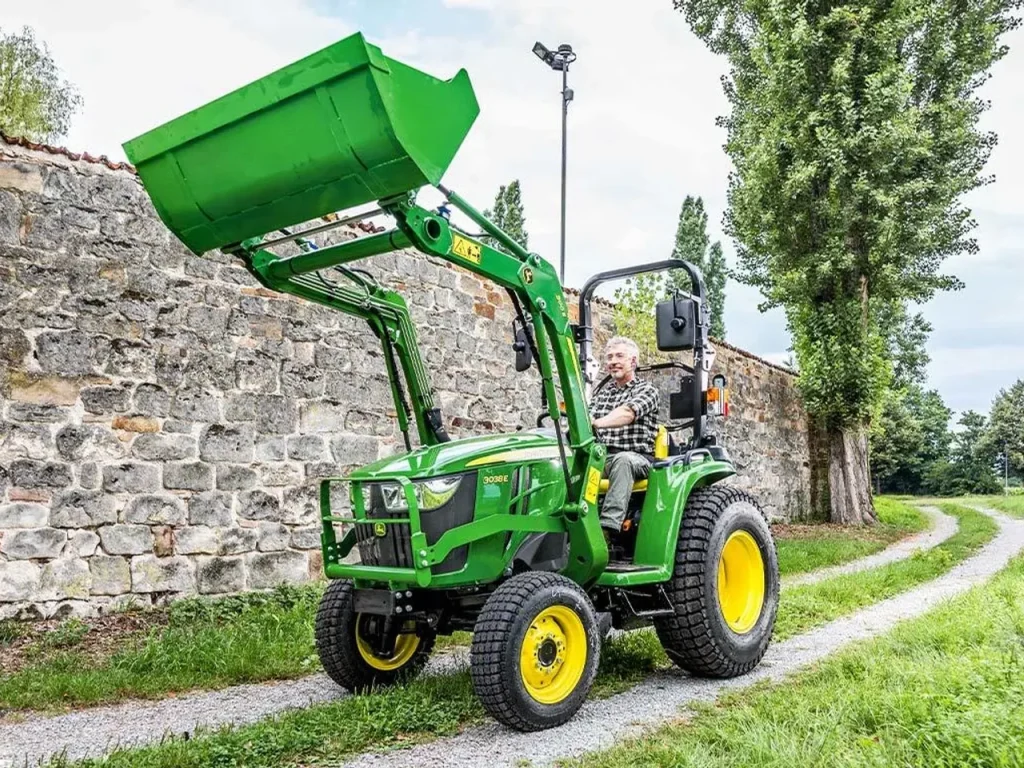
A compact tractor is a small, four-wheel-drive diesel tractor of roughly 20 to 66 engine horsepower, built with a Category 1 three-point linkage and a rear PTO so it can run proper farm implements. It sits between a garden tractor and a utility farm tractor.
Dealers split the class into three chassis sizes:
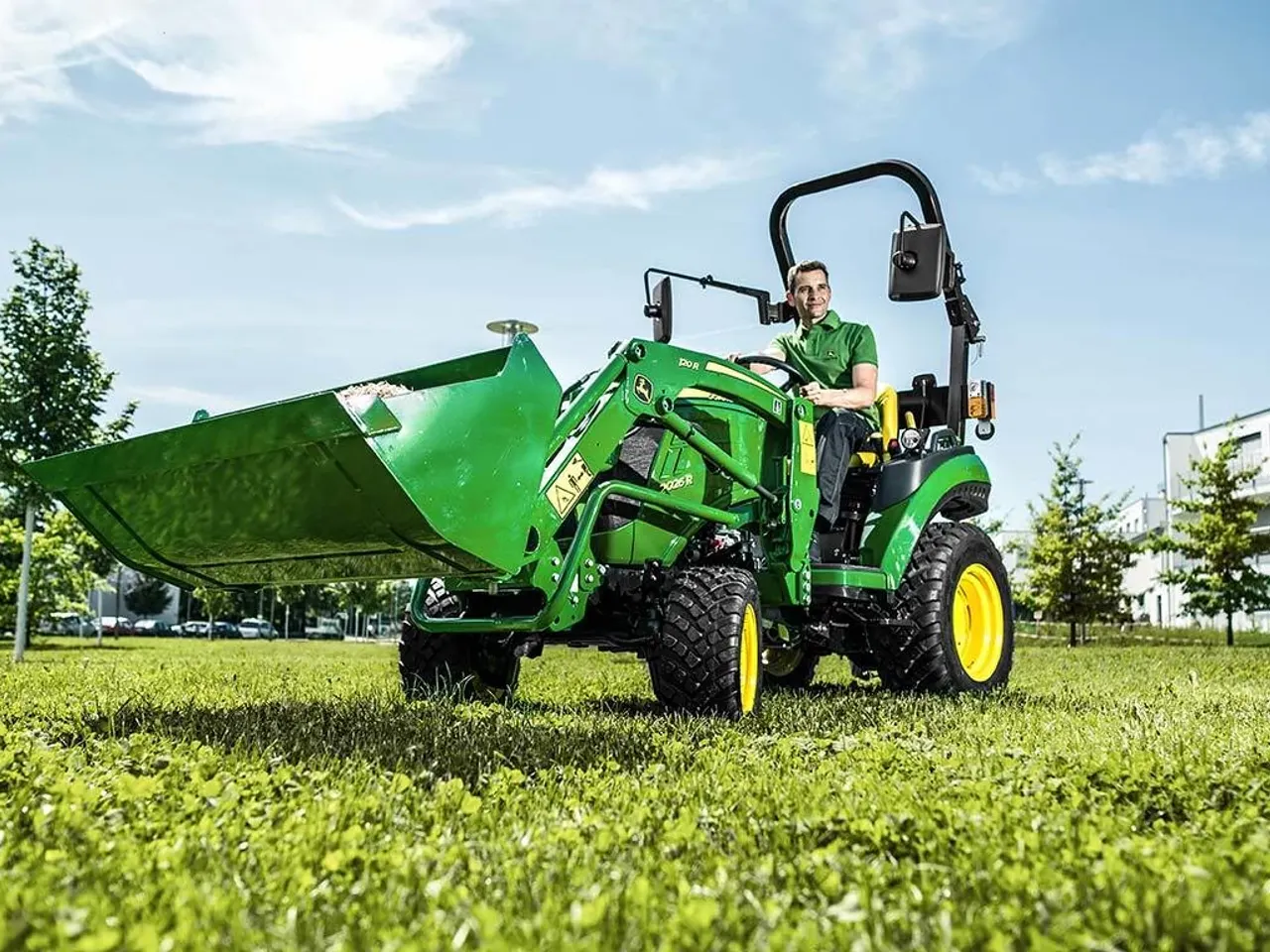
- Sub-compact (small chassis). Around 20 to 26 hp and about 1.2 m wide. The John Deere 1R Series weighs 700 kg and lifts 525 kg on the linkage.
- Compact (mid chassis). Around 24 to 46 hp and 1,050 to 1,700 kg. The John Deere 3E Series and 3R Series sit here.
- Compact utility (large chassis). Around 49 to 66 hp, 1,710 to 2,120 kg, with a 1,420 kg linkage lift. The John Deere 4M and 4R Series cover this.
The jump between chassis sizes matters more than the jump in horsepower. Weight, wheelbase and hydraulic flow all step up with the chassis, and that’s what you feel with a full bucket on a slope.
Engine horsepower vs PTO horsepower: the number that matters
PTO horsepower is the power that reaches your implement, and it’s always lower than the engine figure on the badge. Size your tractor on PTO horsepower when you plan to run a flail, topper, rotavator or post driver.
| John Deere series | Engine hp | PTO hp | Linkage lift (kg) | Weight with ROPS (kg) | Width (mm) |
|---|---|---|---|---|---|
| 1R (1026R) | 25.2 | 18 | 525 | 700 | 1,200 |
| 2R (2025R to 2032R) | 24-31.4 | 18-24 | 650 | 805-915 | 1,295-1,360 |
| 3E (3036E) | 36.6 | 30 | 946 | 1,050 | 1,434 |
| 3R (3033R to 3045R) | 32.8-44.6 | 25-35 | 1,148 | 1,400 | 1,323-1,728 |
| 4M (4049M, 4066M) | 49-65 | 36.9-54 | 1,420 | 1,710 | 1,806-1,987 |
| 4R (4049R, 4066R) | 49-65 | 36.9-54 | 1,420 | 2,120 (cab) | 1,806-1,987 |
Source: John Deere compact utility tractor brochure, European specification. Current UK model numbers (such as 3025E, 3038E, 3039R and 3046R) differ slightly, so check the latest spec sheet with TAG before ordering.
Two things stand out. First, the 1R gives up 7 hp between engine and PTO, which is why a sub-compact struggles with a 1.5 m flail. Second, the 3E and the smallest 3R make almost the same power, but the 3R is 350 kg heavier and lifts 200 kg more. That’s the loader buyer’s tractor.
Match the tractor to the implement, not the field
Every implement has a minimum tractor power and a weight, and your tractor needs to clear both with margin. Check the manufacturer’s spec sheet before you fall in love with a flail mower that’s too big.
| Item | Working width or type | Tractor power needed | Weight (kg) |
|---|---|---|---|
| Amazone Groundkeeper GH 1350 flail collector | 1.35 m | 30-60 hp | 570 |
| Amazone Groundkeeper GH 1500 flail collector | 1.5 m | 40-80 hp | 600 |
| John Deere H120 loader (fits 1R) | Lift at pivot, full height | 380 kg | n/a |
| John Deere H165 loader (fits 3R) | Lift at pivot, full height | 678 kg | n/a |
| John Deere D170 loader (fits 4M) | Lift at pivot, full height | 1,087 kg | n/a |
Sources: Amazone Groundkeeper technical data and the John Deere compact utility tractor brochure.
Notice the Amazone GH 1500 weighs 600 kg empty. Hang that on a 1R with a 525 kg linkage limit and the front wheels lift. The same mower on a 3E, with 946 kg of lift, is a comfortable match. A plain topper needs far less, and a 1.5 m topper on a 25 hp tractor will keep a few paddocks tidy all summer.
Do you need a front loader?
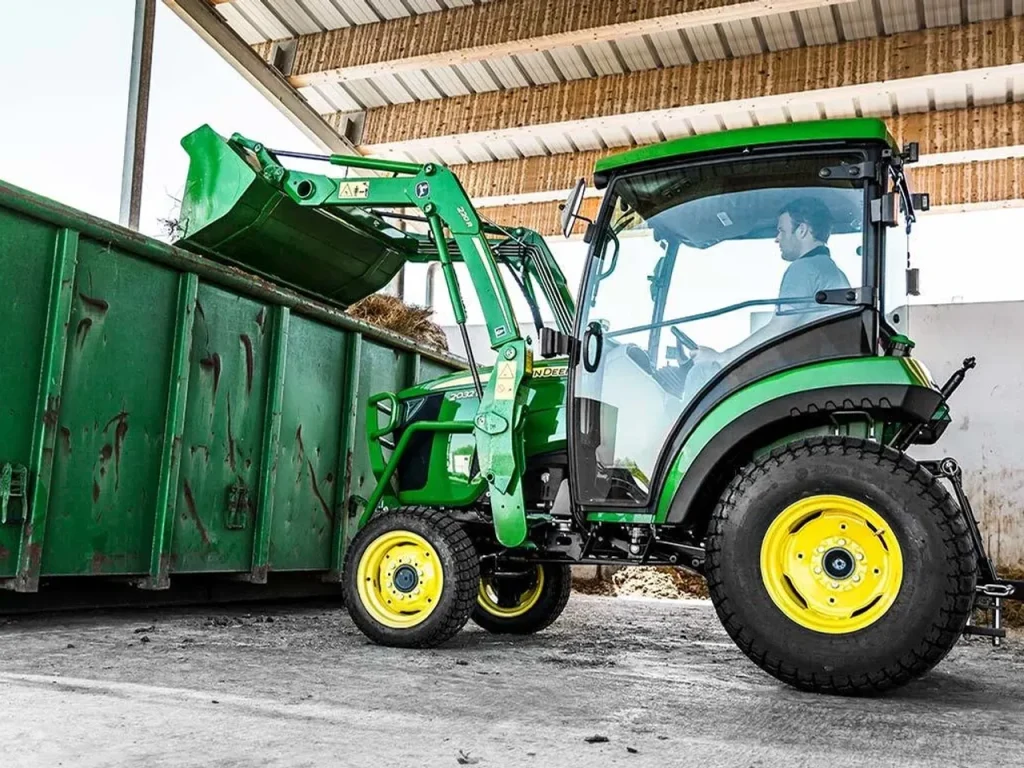
Yes, for almost every smallholding and equestrian buyer. A loader turns a mowing machine into a yard machine, and it’s the single biggest reason people size up.
Loader work changes what you should look at:
- Rear ballast. A loaded bucket at full height unloads the rear axle. You need a heavy implement or wheel weights on the back.
- Hydraulic flow. The 1R pumps 24 litres a minute in total; the 3R pumps 52.5. Faster flow means faster cycles when you’re mucking out.
- Wheelbase and weight. HSE warns that loads and attachments change a tractor’s centre of gravity, so the heavier, longer machine is the safer one with a bucket in the air.
Nearly every compact tractor we sell at Tallis Amos Group leaves with a loader fitted. The few customers who skip it usually come back for one within a season.
Not sure which loader fits your yard? Call the TAG turf team on 0345 222 0456 or book a demo at your nearest depot.
Hydrostatic or manual transmission?
Choose hydrostatic if you’ll do loader work, mowing or anything with constant stop-start and direction changes. Choose a power reverser or manual shuttle if you’ll spend long hours pulling a trailer or a cultivator in a straight line.
Hydrostatic (John Deere calls it Hydro or eHydro) uses two pedals, one for forward and one for reverse. There’s no clutch to wear and no gear to miss while you’re watching the bucket. It’s standard on the 1R, 2R and 3E. The 3R and 4M offer a 12 by 12 PowrReverser instead, which shifts forward to reverse hydraulically and suits long field work.
In our workshops across five depots, the compacts that arrive with worn clutches are almost always manual tractors that spent their lives on daily loader work. For a yard tractor, hydrostatic pays for itself.
Access, storage and ground: the checks people forget
Measure your narrowest gateway, your stable doorway and your shed before you decide on size. The spec table above gives widths of 1.2 m for a 1R up to almost 2 m for a 4R, and a loader adds length you’ll notice in a tight yard.
Then look at your ground:
- Wet or sloping fields favour a heavier tractor with agricultural R1 tyres for grip. Four-wheel drive is standard on every John Deere compact.
- Lawns, arenas and sports fields want turf R3 tyres and a lighter tractor to avoid rutting.
- Mixed yards usually settle on industrial R4 tyres, which balance grip and ground care.
Finally, think about where it sleeps. A 1R with a folding roll bar fits under a 2 m lintel. A 4R cab stands 2.47 m tall and won’t go in a standard garage.
Licence, road use and red diesel rules in the UK
A full car licence includes category F, so you can drive an agricultural tractor on the road without a separate test. The rules tighten at 16, and the fuel rules depend on what the tractor is used for.
Age and width. From 16 you can hold a category F licence, but only for tractors under 2.45 m wide towing trailers under 2.45 m wide with two wheels or four close-coupled wheels. From 17 those limits lift. See GOV.UK: learning to drive a tractor. Every John Deere compact is under 2 m wide, so all of them qualify.
Purpose. Category F only covers tractors used mainly for agriculture or forestry. Other work needs the relevant goods vehicle entitlement, as set out in the GOV.UK tractors regulations guide.
Red diesel. Rebated diesel is allowed for agriculture, horticulture, aquatic farming or forestry, and for cutting verges and hedges that border public roads. Most landscaping and leisure use was excluded from April 2022. HMRC’s Excise Notice 75 has the full list. If you keep horses for leisure, ask your accountant before you fill up with red.
Safety: ROPS, seat belts and slopes
Every compact tractor you buy should have a roll-over protective structure (ROPS) and a lap belt, and you should use both on any ground that isn’t flat. The HSE is blunt about it: all vehicles can overturn, and it happens on banks, ditches and ramps as often as on hills.
The HSE guidance on overturning tractors sets out the basics:
- Check the roll bar or cab is in good condition and correctly bolted on. Corrosion and the wrong bolts cause them to fail.
- Fit a lap belt if one wasn’t supplied, and wear it.
- Turn uphill when working across a slope, and come down straight on the gentlest gradient.
- Four-wheel-drive tractors are likely to be safer on slopes than two-wheel-drive.
- Stay in the seat in an overturn. Most deaths involve people who jumped or were thrown clear.
Every John Deere compact from the 1R up ships with a folding ROPS or a cab, a PTO brake and an operator-presence switch. Those are reasons not to buy a 30-year-old grey tractor to save money.
How to choose your compact tractor size in 7 steps
Work through these in order and the answer to “what size compact tractor do I need” usually falls out by step 5.
- List every job for a full year. Mowing, topping, harrowing, mucking out, moving hay, hedge cutting, snow, trailer work. Mark the ones you’ll do weekly.
- Find your heaviest implement. Look up its weight and minimum tractor power on the maker’s spec sheet. That sets your floor for PTO horsepower and linkage lift.
- Decide on a loader now, not later. If yes, move up one chassis size from what the implement alone would need.
- Measure access. Narrowest gateway, doorway and shed height. Cross off anything that won’t fit.
- Pick the transmission. Hydrostatic for yard and loader work, PowrReverser for long pulling jobs.
- Check the road and fuel rules. Who will drive it, how old are they, and will any use fall outside agriculture?
- Demo it on your own ground. A tractor that feels right in a showroom can feel light with a full bucket on your bank. TAG runs demonstrations from all five depots.
If you’re still torn between two sizes, buy the bigger one. Nobody trades a compact tractor in for having too much lift.
Grants and finance for compact tractors
Grant funding in England has paid towards listed implements rather than the tractor itself, and the standalone scheme has now ended. Finance is the usual route for the machine.
The Farming Equipment and Technology Fund 2026 closed to applications on 12 May 2026. It offered £1,000 to £25,000 per theme at 40% or 50% of the item cost. Defra has said it was the final standalone round, with a simpler combined offer planned from 2027. Wales runs separate schemes; see our note on the Welsh small grants efficiency scheme.
TAG can arrange finance on new and used machinery, including ex-hire tractors and used stock. Tallis Amos Group Ltd is authorised and regulated by the Financial Conduct Authority, FRN 698313, and acts as a credit broker and not a lender. Finance is available subject to status.
Frequently asked questions
What size compact tractor do I need for 5 acres?
For 5 acres, a 25 to 38 hp compact tractor such as a John Deere 2R or 3E is the usual fit. That gives 18 to 30 hp at the PTO for a 1.35 m flail or a topper, plus enough linkage lift for a loader. Go to a 3R if you’ll do daily loader work.
What is the best tractor size for a small farm?
For a small farm of 5 to 15 acres with livestock, a 33 to 46 hp compact tractor with a front loader is the best all-round size. It runs a 1.5 m flail collector, lifts a round bale and tows a loaded trailer. Below 5 acres you can drop to 25 to 38 hp.
How do you determine what size tractor you need?
Start with your heaviest implement, not your acreage. Its spec sheet gives a minimum tractor power and a weight. Choose a tractor whose PTO horsepower and linkage lift clear both with margin, then add a chassis size if you want a loader. Acreage only refines the choice.
Is 25 hp enough for a compact tractor?
Yes, for up to about 5 acres of mowing, topping, harrowing and light loader work. A 25 hp compact such as the John Deere 1026R delivers 18 hp at the PTO and lifts 525 kg on the linkage. It isn’t enough for a 1.5 m flail collector or heavy muck handling.
What can a compact tractor run?
A compact tractor runs toppers, flail mowers, chain harrows, rotavators, post drivers, hedge cutters, fertiliser spreaders, log splitters, trailers and front loaders. The limit is set by PTO horsepower, hydraulic flow and linkage lift. A 30 hp PTO handles most 1.5 m implements; a 54 hp PTO handles 2 m plus.
Do I need a bigger tractor for a front loader?
Usually, yes. Loader work needs weight for stability, rear ballast to keep the back wheels planted and hydraulic flow for speed. Moving from a John Deere 3E to a 3R adds 350 kg and 17 litres a minute of flow for similar horsepower. That’s the difference you feel with a full bucket.
Should I choose a hydrostatic or manual compact tractor?
Choose hydrostatic for loader work, mowing and yard jobs with constant direction changes. There’s no clutch to wear. Choose a PowrReverser or manual shuttle for long hours towing or cultivating in a straight line. Most smallholders and equestrian yards are better served by hydrostatic.
What is the best compact tractor in the UK?
There’s no single best compact tractor, because the right one depends on your land, implements and access. At TAG we supply the John Deere 1R to 4R range because every model has four-wheel drive, a Category 1 linkage and parts and servicing from five depots within reach of our customers.
Can a 16 year old drive a compact tractor on the road?
Yes, with a category F licence. At 16 the tractor must be under 2.45 m wide and any trailer under 2.45 m wide with two wheels or four close-coupled wheels. Every John Deere compact tractor is under 2 m wide, so it qualifies. From 17 the width limits no longer apply.
Talk to TAG about the right compact tractor
If you’re still asking what size compact tractor do I need, bring your job list and your gateway measurements to Tallis Amos Group, a John Deere main dealer supplying agricultural and turf machinery across the West Midlands, South Wales and the Cotswolds. Our turf team will match you to the right chassis, loader and transmission, and demonstrate it on your own ground.
Call 0345 222 0456 or send an enquiry through our contact page. You can also browse our compact tractors and Gator utility vehicles online, with servicing and genuine parts from all five depots.
About the author
Colin McIntyre is Turf and Commercial Sales Director at Tallis Amos Group, where he leads the turf and commercial sales team across the group’s five depots in Evesham, Kemble, Leominster, Narberth and Allscott. Tallis Amos Group has been a John Deere dealer since 1966 and traces its roots to 1882.